RESEARCH
The novel began in 1998 when I read a paragraph about a redoubtable young woman called Charlotte Badger in James Belich’s Making People and it resonated. At first I hoped to write a biography but after a research trip to Australia with the aid of Creative New Zealand, I felt there wasn’t enough factual evidence to write a convincing non-fiction book. However, having carried Charlotte about in my head for two years and having read extremely widely about the era, I still felt compelled to tell her tale. What sort of woman becomes a pirate?
The actual facts of Charlotte Badger are probably best summarised in the Dictionary of New Zealand Biography (Omsby, Mary Louise. ‘Badger, Charlotte fl 1806-1808. URL: http://www.dnzb.govt.nz/). The mutiny on the Venus was reported in the Sydney Gazette, 27 July 1806 and further records of the time can be read in the Historical Records of New South Wales. Descriptions of the main mutineers from the Gazette are as follows:
Benjamin Burnet Kelly, chief mate, says he is an American…..Joseph Redmonds, a seaman, a mulatto. John William Lancashire, convict, by trade a painter. Catherine Hagerty, convict; fresh complexion, much inclined to smile. Charlotte Badger, convict; very corpulent, has an infant child.
Out of the many books I read, I found the following particularly informative: The Fatal Shore (Robert Hughes), The Birth of Sydney (Tim Flannery), Convict Women (Kay Daniels) and Depraved and Disorderly (Joy Domousi). I read several biographies of Samuel Marsden as well as his personal records. As much as possible, I used primary sources to avoid the cultural and psychological filters of 20th century sensibilities and I deliberately avoided reading any literature set in that era. Despite the appalling hardships of the time, the diaries and letters reveal an unquenchable spirit that I hoped to capture. Because this is a work of fiction, I used some poetic licence with detail such as moving the floggings described from 1800 to 1801. I borrowed heavily from Birth of Sydney for the flogging scene and the descriptions of the Irish uprising and the Islamic festival.
For the New Zealand section Savage’s Account of New Zealand in 1805 (ed. A. D. McKinlay) was particularly useful as well as Narrative of Voyage to New Zealand, (J.L. Nicholas). Unto the Perfect Day: The journal of Thomas James Jagger: Feejee 1838-1845 (ed. E &W Kessing-Styles) provided a fascinating account of missionaries’ lives in Fiji, despite being set several decades later than my novel. Spelling was not standardised at that time and I have kept some of the more common spellings of names used at that time. Tippahee, for example, is in fact Te Pahi, the venerable Maori leader.
On my research trip, I spent many happy hours in the splendid archives both at the Sydney Library and The Rocks although records for the years 1800-1806 are not complete so it was difficult to find much information about either Charlotte or Catherine. The birth of a son to a Catherine Hagerty was recorded in 1797. I could not find any records of what happened to Kelly after he had been taken away in irons and Lancashire seems to have disappeared between New Zealand and Sydney. He is recognised as one of Australia’s early artists and The Sydney Gazette records several of his earlier trials. These newspapers were a valuable source of trivial information and provided much of the flavour of the time. Charlotte seems to have kept out of trouble during her time in Sydney for I could not find mention of her anywhere.
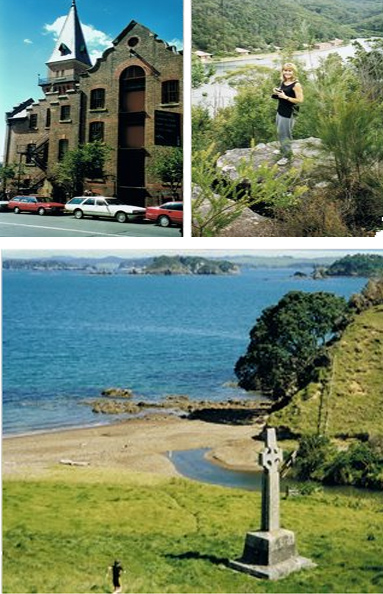
While in Sydney, I also visited museums and spent hours wandering around The Rocks and the streets around the harbour, trying to peel back the layers of the modern city to recreate in my mind the fledging community that once lined those shores. The sight of the bed of the Tank Stream beneath the General Post Office was strangely moving. A visit to Old Sydney Town was both great fun and extremely useful. The art of the time was also extremely evocative and a print of John Eyre’s painting of Sydney 1808 hung above my computer during the writing of the novel.
Charlotte disappears again from historical record after 1807. One source is tantalisingly reports an English woman travelling with a child to America on a whaler some ten years later, supposedly fleeing the Maori. Certainly, Marsden makes no reference to her whatsoever, when he arrived in the Bay of Islands with his missionaries in 1814. A gun of the type she might have used during the mutiny is lodged at Te Papa Museum, Wellington.
I tried hard to be faithful to the spirit of the times and endeavoured as far as possible to be factually accurate but this is remains most definitely a work of fiction. While I based some characters on actual people, in the end they too are merely fictional interpretations based on a few subjective contemporary observations and a considerable helping of imagination.